[Hot Forward] The central bank suddenly released $200 billion! Next week, we'll get paid for this
Hot chip forecast QA: The central bank suddenly released $200 billion! It's only next week that Unit A will make money. 2026-07-25T02-17-48
[Hot-topic forward QA] 2026-07-25T02-17-48 One-click forecast from Gity Times.
Business material
- Title: The central bank suddenly released $200 billion! It's only next week that A's gonna make money.
- Category: Integration
- Heat: 100
- Materal ID: 234deb81-6d9d-408e-92f4-81b5cce0e092
html
The central bank suddenly released $200 billion! It's only next week that A's gonna make money.
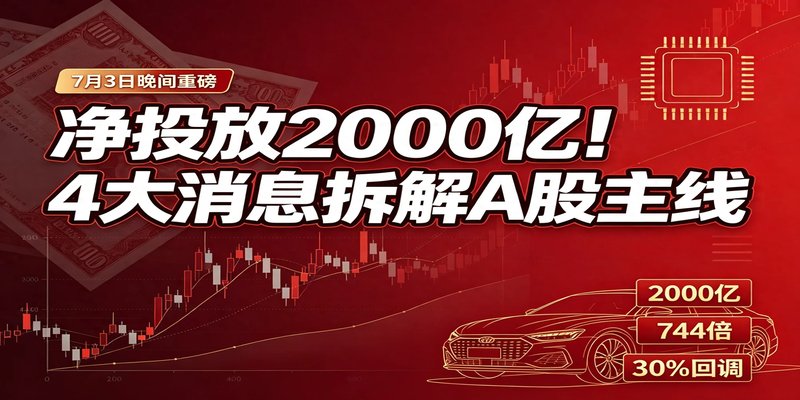
On the evening of 3 July, four deep-water bombs were dropped simultaneously by the policy and industry: the cancellation of ship tax exemptions, a net central bank release of 200 billion dollars, a sharp 744-fold increase in the performance of the storage poles, and a high-profile white light on Wall Street. These four messages cut across monetary policy, the automobile industry, semiconductor performance, and overseas capital movements, and the interlocking of space has a direct impact on the pace of events next week. I break every piece of information and explain the market logic behind it, and you know where the money goes.
The Ministry of Finance, the General Tax Administration and the Ministry of Industry and Communications jointly issued Circular No. 19 of 2026, whereby, as of 1 January 2027, the policy of reducing by half the tax on cars and boats used for energy conservation expired and taxes were reinstated for all commercial vehicles that were fully electric, mixed commercial vehicles, additional commercial vehicles and commercial vehicles for fuel cells. The policy has been in place for 15 years and now stops, with a number of the first reaction being that the new energy truck is about to end.
Now don't panic. There are two critical boundary points to see. This adjustmentIt doesn't affect the use of a purely electric car.This type of car is not at all covered by a ship tax, and the electric car you buy to take off duty is completely unaffected. The real tax is to be paid in the form of extra and interpolated vehicles, as well as in the form of new energy commercial vehicles for the logistics of passenger traffic, which are indeed under pressure in the short term.
From the perspective of industrial evolution, the annual sales of new domestic energy vehicles were less than 1 million 15 years ago and markets had to be built with subsidies and tax breaks. By 2025, the annual sales volume had exceeded 16 million, the global market share had been at the top, and the industry had moved from policy-driven to market demand-driven. The removal of the Generalized Preferences was a trend that should have been anticipated.
Following the retreat of the policy dividend, the rise in stock prices for new energy vehicles can only be achieved on two legs: the product is competitive enough to be sufficiently competitive to allow for export capacity abroad.
At the operational level, the whole new energy unit and hybrid parts have been down for days this week, with a number of shares falling more than in the past.15%The market's expectations of the policy slowdown have been almost digested, and there is the possibility of a drop-and-break recovery. However, medium- and long-term thinking needs to change, and high-valued blenders need to be treated with caution. Rather, they focus on pure electricity going out of the sea, and on greater risk resistance in the overseas supply chain.
On the evening of July 3rd, the Central Banker announced a heavy operation: July 6th, Monday.$1 trillion 3 month buybackThe maturities of the current period were $800 billion, resulting in a net liquidity of $200 billion. For the first time since March this year, the central bank implemented a net release of three-month instruments, ending the four-month back-to-back pattern.
Breakback repurchases are a tool to put medium- and long-term money into the market, with the simple understanding that banks give bonds to the central bank in exchange for money. The continuous contraction ahead is due to the strong interest rate expectations of the Federal Reserve in the first half of the year, and the early tightening of our funds against external fluctuations. The recent rise in interest rates abroad is expected to increase, with a build-up of government bonds issued in July, a concentration of pressure on end-of-month maturities, and a decisive move to release liquidity to the market as a whole.
It is widely believed by head voucher analysts that this trillion operation has sent a clear signal that the moderate tightening of the currency cycle in the first half of the year has ended and that overall liquidity has remained adequate for the third quarter. The loose environment supports Unit A as a whole, especially the pre-dumping technological track and high-end manufacturing, with adequate funding for rehabilitation.
But let's be reminded not to call the whole cow market when you hear “water”. The launch was a precision run, not a flood, and the market remained structural. Funds will only be concentrated on sub-tracks where semi-annual performance is realized, industrial logic is too rigid, and it is difficult to get out of a continuous pattern of simple subject matter, small votes that are not supported by performance.
Last night, Bolong, the head of the chip, disclosed a half-yearly advance of 2026, which directly updated the historical record of the A-unit storage block. The first half of the camp.22 billion to 25 billion yuan, same year growthBetween 116 and 145 per centnet profit due to motherBetween $9.2 billion and $11 billion.Only $14.76 million in the same period last year, with the highest increase over the same period74394%The conversion is 744 times. The parallel surge in non-net profits, with no one-time gains, was the result of the main operation.
With hundreds of times the increase, many of the first reactions of the bulk were that last year ' s base was too low for reference. But when you open up the quarterly data, the real picture is clear: the company's net profit in the first quarter of 2026.$3.862 billionSingle-season net profit, second quarterBetween $5.3 billion and $7.1 billion.Rings are growing faster.Between 38 and 85 per centI don't know. The size of the profits in the second quarter is significantly higher than in the first quarter, and the industry is continuing to move upwards, rather than pulsating the surface.
Performance outbreaks are underpinned by two core logics, with industry data validation. First, there is a serious imbalance in the supply of and demand for global stocks of chips. In the last two years, the industry ' s low valley, the scaling-up plans for major plants, the outbreak of AI servers and end-end smart equipment in 2026, the continuing high demand for DRAM, NAND storage chips, the successive upwards in the price of the crystal round, and the significant recovery of the company ' s Maori ratio. Jiang Polo has locked up a large stock of low-priced crystal round at the end of the cycle and now enjoys a perfect price increase.
Second, end-side AI opens the company ' s second growth curve. The company has developed a self-researched primary-control chip suitable for local AI equipment, and has completed a joint technology optimization with AMD for terminal equipment carrying home-based stored products, with direct reductions in AI running DRAM consumption40%I don't know. Orders for household smart hardware and edge computing equipment continue to be placed and the long-term growth of the ceiling is further raised.
Performance is the anchor of stock prices, and the growth without performance support is called bubble, and the increase in performance is growth.
But there's also a risk: the increase in stock prices during River Poloon has been alarming and the current market value exceeds.$260 billion.A significant part of the optimistic expectations of the storage cycle for price increases have been reflected in stock prices ahead of time and are typical of good payouts. There are no low-suspensed bulky blindly pursued, and the price is higher for sub-headings such as upstream storage of materials, support equipment, etc., after the plate is returned.
Local time, on 2 July, Michael Burry, a prototype investor in the Big Open movie, made public disclosure:$105,1.87/unitThe price coupons are used for air and light technology, along with early warning, and the current global AI infrastructure firm valuation is highly bubbled, and the U.S. semiconductor plate is present as a whole.30%Right or right, callback space.
Burry wasn't the type of short-line guy who used 42 years of historical data to support his judgment: Mi-ray as a pure storage cycle unit, which had happened in the last few decades. Pass.34 times.More than 30 per cent of the evacuations were significant. The current stock price is a deviation from the 200-day average and has reached a historical extreme since the Internet bubble in 1984, with valuation completely detached from the enterprise ' s long-term profitability, with only a median of the firm ' s long-term net asset return7%The return on investment was low and the bursting of the bubble was only a matter of time.
As soon as the U.S.U. responded, U.S. Light technology fell sharply on Wednesdays and Thursdays, and the cumulative decline exceeded.16%The closing price.US$ 975.56
> , the entire Philadelphia semiconductor index dives simultaneously, and the NASDAQ technology plate is being dragged down. The logic of a global chain of chips is clear: US-based semiconductor adjustments can be transmitted to Korea’s large storage plant, thus affecting the short-term mood of the A-stock semiconductor plate, which is the external core of the ongoing shock adjustment of domestic chips this week.However, the current fundamentals of the Central American and American storage industry are fundamentally divided without excessive panic. The rise in beauty light is based entirely on AI valuations and the firm ' s real profit stability is weak; the domestic storage chain is underpinned by the dual logic of substitution of supply and demand for domestic production, and the firms associated with the Jiang Polo and Long Chong storage chains have achieved high performance and bottom-up profits, with much less space falling than the US chip unit. The split line will continue, and the performance will establish stronger features of domestic production resistance.
Put the four blanks together, the market as a whole will be clear next week. I'll give you an objective combing from three dimensions, without predicting points, without recommending a unit, with a shared observation logic.
The liquidity dimension is clearly more profitable than space. The trillions of medium- to long-term capital invested by the central bank directly hedged the July funding gap, the overall liquidity of the market was relaxed, and there was no basis for a sustained and substantial decline in the bulk. Even if there is a short-term reversal next week, the bottom is strong enough to avoid a systematic collapse of excessive panic.
The size of the plate is clear. The main interest line is semiconductor storage and AI computing hardware, storage of chip industry cycle reversals, six months of collective bursting of lead enterprise performance, folding of liquidity easing and repair power after plate readjustment, with a focus on domestic production support enterprises with real orders and performance on the ground. The main line of pressure is mixed cars and new energy commercial vehicles, with a long-term downgrading of industry valuations by ship-tax policies, short-term failure to sustain large increases in plates, and short-term rebound opportunities after overfalls. External repression is the risk of an offshore semiconductor valuation bubble, which in the short term suppresses the mood of high-tech firms and avoids small votes made with high-grade pure subject matter.
There are three core lines of thinking at the operational level. First, the structural segmentation of markets will intensify next week, with only half-yearly prognosis and industrial logic-enabled tracks to avoid the pure subject matter of non-performance. Second, the new energy plates need to be disaggregated, and the pure electric-car lanes of home use are not subject to policy shocks and are subject to retracing; additional and commercial new energy vehicles are expected to watch as much as possible. Thirdly, the semiconductor plate does not follow the double-bid lead, priority layout upstream material and equipment is broken down, and valuations are at a low level and the chances of a gradual release of the breakdown are safer.
The four heavy stories seem to be unconnected, pointing to the same bottom logic: the global capital market is completing a valuation reshaping round. The overseas science and technology units rely on stories for high valuation, and risks are gradually accumulating; domestic industries rely on real demand and performance to support stock prices; policies shift from inclusive support to good and bad; and liquidity to the core of the real economy.
Stock builders cannot just stare at the rise and fall of a single day, ignoring long-term changes in policy and industry cycles, following the hot spots of the wind and eventually becoming more vulnerable at the top. When the offshore AI bubble begins to loosen, hard-tech domestic production relies on cycle reversals and domestic production as an alternative to moving out of independent situations, which break-out tracks can cross short-term global fluctuations? When industrial policies are phasing out of inclusive subsidies and moving out of long-term industries in the future, is core competitiveness a policy dividend or a share of its technology and global markets? These issues deserve serious reflection by each of the diasporas.
I think it's enlightening and I'm looking at it.
Editing notes
- Keep the core facts of the hot topic.
- Over and except matter for plaza cards.
- - Yes, sir.
It's not like you're going to have to do it.